I'm pretty particular about my backups at work. In fact, we have a setup where if a nightly backup fails, we get a page in the middle of the night so we can address the problem.
At home, it's a different story. I've got a Windows 2000 PC that I haul out the CD-R's a couple times a year and backup what I think are the important files. At first it wasn't so bad, a couple CD's and I was done. But pictures from a digital camera tend to eat up space at a pretty decent rate. The last backup I did was 18 CD-R's.
About the same time, I got the opportunity to help someone with their own backup issues. They were getting ready to retire a computer and wanted a way to move about 60G of data from one machine to another. So I investigated some options and found a nice 320G SimpleTech USB drive at Costco. We setup the drive and the ArcSoft TotalMedia Backup in about 20 minutes and completed a test backup in another hour or so.
I was so impressed, that I bought one myself. For $89, I just couldn't go wrong.
So far, my impression is TotalMedia can get the basics done. However, as a backup professional I need the ability to tweak things. I'm still doing a backup every day, but looking at other options. Stay tuned for updates.
Thursday, June 19, 2008

Monday, June 16, 2008
Microsoft Vista Oy Vey!
I needed a new laptop for my home. OK, maybe "need" is not the correct word, but you get my picture.
So I did what I always do. I navigated to dell.com and purchased a Inspiron 1525 with a 15" screen, 4G of RAM and Microsoft Windows Vista Home. I went through all the normal setup things and had it on my wireless network in about 15 minutes.
So far, so good. Then I tried to add a network printer [Accept or Deny] that was attached [Accept or Deny] to my W2K desktop. Since W2K doesn't serve the drivers like XP, I had to install the drivers [Accept or Deny] for my printer before I could print. Then I had to tweak my firewall settings [Accept or Deny] so that I could print to my network printer. I used to think that the Apple Commercial was exaggerating, but it's not.
Then, to add insult to injury, I tried to print a document. First I had to activate Microsoft Word, which was simple. I typed in some text and...
Wait a second, where's the "save" button...
And what happened to the "File" menu...
Arg, even "Help" isn't on the menu any more.
I finally figured out that you have to click that stupid looking button at the top before you can "Save", "Print", "Open" or do anything you are used to.
Great way to enhance my productivity. Now it takes me 5 minutes to open and print a document instead of two mouse clicks. Word 2007 is a step backwards.
So I did what I always do. I navigated to dell.com and purchased a Inspiron 1525 with a 15" screen, 4G of RAM and Microsoft Windows Vista Home. I went through all the normal setup things and had it on my wireless network in about 15 minutes.
So far, so good. Then I tried to add a network printer [Accept or Deny] that was attached [Accept or Deny] to my W2K desktop. Since W2K doesn't serve the drivers like XP, I had to install the drivers [Accept or Deny] for my printer before I could print. Then I had to tweak my firewall settings [Accept or Deny] so that I could print to my network printer. I used to think that the Apple Commercial was exaggerating, but it's not.
Then, to add insult to injury, I tried to print a document. First I had to activate Microsoft Word, which was simple. I typed in some text and...
Wait a second, where's the "save" button...
And what happened to the "File" menu...
Arg, even "Help" isn't on the menu any more.
I finally figured out that you have to click that stupid looking button at the top before you can "Save", "Print", "Open" or do anything you are used to.
Great way to enhance my productivity. Now it takes me 5 minutes to open and print a document instead of two mouse clicks. Word 2007 is a step backwards.
Tuesday, May 13, 2008
Something to be aware of (10.2.0.4)
My standard install of 10.2.0.3 included 23 patches at last count. When the 10.2.0.4 patchset came out a few weeks ago I checked it and decided that since my 23 patches were included in 10.2.0.4, it would be a good idea to upgrade to that version.
I first got underway in my development environment on x86_64. I have several small dbs with 2G SGAs on a single box. The patch/upgrade process went flawless and I encountered no issues at all during the upgrade.
I usually like to run the patch in development for a month or so before I apply it to my production enviornment. However, I was fighting a nasty bug on one of my 10.2.0.3 production dbs that was fixed in 10.2.0.4 but a backport wasn't available to 10.2.0.3 at the time. So after a week in development, I decided to upgrade that production db to 10.2.0.4. That db usually runs with a 16G SGA and when I tried to start the instance with the 10.2.0.4 software, I got the venerable:
I first got underway in my development environment on x86_64. I have several small dbs with 2G SGAs on a single box. The patch/upgrade process went flawless and I encountered no issues at all during the upgrade.
I usually like to run the patch in development for a month or so before I apply it to my production enviornment. However, I was fighting a nasty bug on one of my 10.2.0.3 production dbs that was fixed in 10.2.0.4 but a backport wasn't available to 10.2.0.3 at the time. So after a week in development, I decided to upgrade that production db to 10.2.0.4. That db usually runs with a 16G SGA and when I tried to start the instance with the 10.2.0.4 software, I got the venerable:
SQL> startup
ORA-27102: out of memory
Linux-x86_64 Error: 28: No space left on device
OK, so I know that usually means that my kernel parameters are off somewhere. It was a Saturday and I didn't have a sysadmin available, so I bumped the SGA down to 12G and the instance started right away and upgraded fine. I figured there was some shared memory parameter that I would research on Monday and we'd be back in business the next week.
I looked at Note 301830.1 thinking maybe my shmall paramter was off, but sure enough I had enough configured. I submitted a TAR and basically let Oracle Support stew on it for a few days.
In the meantime, another DBA in my group got the task to setup a new x86_64 box with 10.2.0.4 so we can move a db. He got the software installed OK, but couldn't start an instance with an SGA of more than about 2G of memory. The kernel parameters were exactly the same as my other box, but he still couldn't start an instnace with any decent amount of memory.
This was just too co-incidental. So we played around with the 10.2.0.4 installation a little more and found that 10.2.0.4 was allocating multiple shared memory segments instead of just one big segment. I used ipcs to find my shmid for the SGA and then used pmap to find out that to allocate a 2G SGA, 10.2.0.4 used about 260 shared memory segments of between 15M and 5M.
Then we installed 10.2.0.3 and tried to start with the SAME EXACT parameter file, and sure enough, one shared memory segment of 2G. In fact, we could allocate almost all the way up to our shmall in one segment.
I'm bug 7016155 and I know others have run into this problem as well. I'm sure bug 7019967 think's he's alone in this, but he's not. As usual, my bug has been sitting out there for about 12 days and nobody has looked at it.
Part II
Click the 10.2.0.4 label below to follow all threads on this issue and the eventual solution.
Then we installed 10.2.0.3 and tried to start with the SAME EXACT parameter file, and sure enough, one shared memory segment of 2G. In fact, we could allocate almost all the way up to our shmall in one segment.
I'm bug 7016155 and I know others have run into this problem as well. I'm sure bug 7019967 think's he's alone in this, but he's not. As usual, my bug has been sitting out there for about 12 days and nobody has looked at it.
Part II
Click the 10.2.0.4 label below to follow all threads on this issue and the eventual solution.
Thursday, April 10, 2008
RMAN-08137 Followup
Before I got a chance to apply my 10.2.0.4 patch, my problem fixed itself! Well, maybe not fixed itself, but certainly went away.
As I was reviewing my backup log from last night, I noticed that my RMAN-08137 error was gone. I didn't do anything different nor did I change anything. In fact, yesterday's backup had the same ORA-08137 error just as I had on the last 12 days.
So what was different? My control_file_record_keep_time was set to 1, so any record of my archived log would surely be gone way before now, right?
No, the control_file_record_keep_time parameter specifies the minimum number of days the recyclable data will stay in the controlfile, not an absolute limit. Sure enough, although my control_file_record_keep_time was set to 1, the latest log from my v$archived_log was from 12 days ago. All the records from the day I had a problem were gone.
Theoretically, I guess I could have switch my logfile a couple thousand times after a day and that would have cleared the issue up.
As I was reviewing my backup log from last night, I noticed that my RMAN-08137 error was gone. I didn't do anything different nor did I change anything. In fact, yesterday's backup had the same ORA-08137 error just as I had on the last 12 days.
So what was different? My control_file_record_keep_time was set to 1, so any record of my archived log would surely be gone way before now, right?
No, the control_file_record_keep_time parameter specifies the minimum number of days the recyclable data will stay in the controlfile, not an absolute limit. Sure enough, although my control_file_record_keep_time was set to 1, the latest log from my v$archived_log was from 12 days ago. All the records from the day I had a problem were gone.
Theoretically, I guess I could have switch my logfile a couple thousand times after a day and that would have cleared the issue up.
Wednesday, April 02, 2008
RMAN-08137: WARNING: archive log not deleted as it is still needed
A couple days ago my network link to my standby databases went dark in the middle of the night. My dbs took notice and started generating log shipping errors in the alert.log. About 10 minutes later, I got a page from my standby db that said his gap was more than the acceptable level and could I please do something. No problem, I just turned log_shipping off until the link came back up. The link came back up later in the day, I resumed log shipping, and most of my dbs recognized the gap and started resending logs.
The operative word being "most".
One of my dbs was shipping an archived redo log when the link went down. When I resumed log shipping, Oracle thought he was still shipping a log and thought the gap started at the next log sequence number. He shipped the current logs just fine, but just wouldn't resolve the gap.
"No worries", I thought, "I'll just rcp the missing file and register them with the standby control file and I'll be on my merry way."
Sure enough, the standby started recovering immediately and caught up in a short time. I thought everything was dandy until I got a page on Monday morning (2 AM, thank you very much) that my log_archive_dest was about to fill up on the primary.
Our standard protocol for freeing up the log_archive_dest is to run an archivelog backup with DELETE INPUT specified. I kicked off the backup, killed the monitor that watched the log_archive_dest, and went back to bed. I set the alarm for 1 hour later just to make sure the backup was done.
When I got back up, the archivelog backup wasn't done and the log_archive_dest was at 99%. I then looked in the directory and saw logs that were 3 and 4 days old which I knew was not correct. I killed the backup, deleted the 4 day old logs, crosschecked, and restarted the backup.
When I got into the office, my main task was to figure out why this happened. When I looked at my RMAN message log, I noticed about every log that was being backed up was accompanied by a warning:
RMAN-08137: WARNING: archive log not deleted as it is still needed
Hmm, that's not cool. Maybe my standby was really out of sync and I just didn't know it. Sometimes the primary will ship logs and the standby will accept but not apply them because it is missing a log. But that wasn't my case, the standby was within one or two logs from the primary.
When I looked at my v$archivelog_history, the "applied" flag indicated that the primary thought a bunch of logs were not applied to the standby. I knew different, as the standby was somewhat current.
At that point, I needed assistance. I filed a TAR and within about 2 hours found out it is a bug (bug 4538727) that is fixed in the 10.2.0.4 patchset. Since the patch just came out, I haven't gotten a chance to apply it to anything so I asked for workarounds.
"None", they say.
Theoretically, I supposed I could recreate my control files and my standby control files. I'm not really excited about doing that.
Until I figure out what to do, I'll just have to use RMAN to delete my logs "backed up 1 times" and crosscheck to manage my log_archive_dest space.
My Resolution, sort of.
The operative word being "most".
One of my dbs was shipping an archived redo log when the link went down. When I resumed log shipping, Oracle thought he was still shipping a log and thought the gap started at the next log sequence number. He shipped the current logs just fine, but just wouldn't resolve the gap.
"No worries", I thought, "I'll just rcp the missing file and register them with the standby control file and I'll be on my merry way."
Sure enough, the standby started recovering immediately and caught up in a short time. I thought everything was dandy until I got a page on Monday morning (2 AM, thank you very much) that my log_archive_dest was about to fill up on the primary.
Our standard protocol for freeing up the log_archive_dest is to run an archivelog backup with DELETE INPUT specified. I kicked off the backup, killed the monitor that watched the log_archive_dest, and went back to bed. I set the alarm for 1 hour later just to make sure the backup was done.
When I got back up, the archivelog backup wasn't done and the log_archive_dest was at 99%. I then looked in the directory and saw logs that were 3 and 4 days old which I knew was not correct. I killed the backup, deleted the 4 day old logs, crosschecked, and restarted the backup.
When I got into the office, my main task was to figure out why this happened. When I looked at my RMAN message log, I noticed about every log that was being backed up was accompanied by a warning:
RMAN-08137: WARNING: archive log not deleted as it is still needed
Hmm, that's not cool. Maybe my standby was really out of sync and I just didn't know it. Sometimes the primary will ship logs and the standby will accept but not apply them because it is missing a log. But that wasn't my case, the standby was within one or two logs from the primary.
When I looked at my v$archivelog_history, the "applied" flag indicated that the primary thought a bunch of logs were not applied to the standby. I knew different, as the standby was somewhat current.
At that point, I needed assistance. I filed a TAR and within about 2 hours found out it is a bug (bug 4538727) that is fixed in the 10.2.0.4 patchset. Since the patch just came out, I haven't gotten a chance to apply it to anything so I asked for workarounds.
"None", they say.
Theoretically, I supposed I could recreate my control files and my standby control files. I'm not really excited about doing that.
Until I figure out what to do, I'll just have to use RMAN to delete my logs "backed up 1 times" and crosscheck to manage my log_archive_dest space.
My Resolution, sort of.
Wednesday, March 26, 2008
Tuesday, March 11, 2008
Maybe I'm starting to get it
Yes, another R12 post. It's all I've been doing lately.
When I first installed 11.5.3, I just went with the default two-tier architecture; Web & Forms on the middle-tier and Reports & CCM on the db host. After a while, I realized that was a mistake for my environment. I should have put everything but the db on the middle-tier. Live and learn, I guess.
R12 was my chance to partially correct that mistake. I had a grand plan to migrate my middle-tier services to a hot x86_64 box and leave my db on Solaris. I figured that would give me an easier path if I needed to scale out either tier.
Except Oracle doesn't have a supported upgrade path on multiple platforms yet.
So I bounced a couple ideas off a very helpful Oracle Support Tech and he prefaced each one with "This isn't supported, but you might try...". I finally settled on a plan and executed it.
First, I collapsed my 11.5.9 tiers on to a single Solaris box. I used the Metalink whitepaper and rapidclone to get everything on my db box.
Then, I upgraded to 12.0.0 and applied the 12.0.4 RUP. At that point, I had a working 12.0.4 system with all my middle tier services on Solaris.
Next, I did a fresh install of 12.0.0 on a Linux box telling the configuration that I was going to have two tiers and my db was going to be on Solaris. Then I deleted my network topology and reran autoconfig that populated the db piece of my topology.
The next step was to apply the 12.0.4 patch to the Linux box. I did this with adpatch, but used the "nodatabaseportion" option because I knew I had already applied the object changes to my db.
The final step was running autoconfig on the middle-tier.
Except for a few glitches here and there, it was a surprisingly straight-forward split. Either I'm starting to get this Oracle Apps stuff or Oracle is finally getting serious about their configuration management.
When I first installed 11.5.3, I just went with the default two-tier architecture; Web & Forms on the middle-tier and Reports & CCM on the db host. After a while, I realized that was a mistake for my environment. I should have put everything but the db on the middle-tier. Live and learn, I guess.
R12 was my chance to partially correct that mistake. I had a grand plan to migrate my middle-tier services to a hot x86_64 box and leave my db on Solaris. I figured that would give me an easier path if I needed to scale out either tier.
Except Oracle doesn't have a supported upgrade path on multiple platforms yet.
So I bounced a couple ideas off a very helpful Oracle Support Tech and he prefaced each one with "This isn't supported, but you might try...". I finally settled on a plan and executed it.
First, I collapsed my 11.5.9 tiers on to a single Solaris box. I used the Metalink whitepaper and rapidclone to get everything on my db box.
Then, I upgraded to 12.0.0 and applied the 12.0.4 RUP. At that point, I had a working 12.0.4 system with all my middle tier services on Solaris.
Next, I did a fresh install of 12.0.0 on a Linux box telling the configuration that I was going to have two tiers and my db was going to be on Solaris. Then I deleted my network topology and reran autoconfig that populated the db piece of my topology.
The next step was to apply the 12.0.4 patch to the Linux box. I did this with adpatch, but used the "nodatabaseportion" option because I knew I had already applied the object changes to my db.
The final step was running autoconfig on the middle-tier.
Except for a few glitches here and there, it was a surprisingly straight-forward split. Either I'm starting to get this Oracle Apps stuff or Oracle is finally getting serious about their configuration management.
Tuesday, February 19, 2008
I'm In!
I went round and round with Oracle Support creating spin-off TARs and transferring it from one group to another. I finally found an article that said one of the 11.5.x versions was really executing fnd_web_sec.validate_login() under the covers.
Might as well give that a try, SINCE I'M STILL WAITING.
So I ran the function on my GUEST user and sure enough, it came back with a "Y" which indicated the GUEST user and password were correct.
I then tried the same for my SYSADMIN user and the function returned "N".
Hmm, that's interesting, let me try it again.
Sure enough, my old SYSADMIN password didn't work for some reason. I posted the results in the TAR and the analyst suggested I change my SYSADMIN password with FNDCPASS.
I changed it, and was in!
If this little tidbit of an upgrade is published somewhere, it sure wasn't obvious to me.
Of course, now I have to figure out why anything using the forms servlet won't come up. And how to use WebADI. And why my printers aren't defined.
But at least I'm in!
Might as well give that a try, SINCE I'M STILL WAITING.
So I ran the function on my GUEST user and sure enough, it came back with a "Y" which indicated the GUEST user and password were correct.
I then tried the same for my SYSADMIN user and the function returned "N".
Hmm, that's interesting, let me try it again.
Sure enough, my old SYSADMIN password didn't work for some reason. I posted the results in the TAR and the analyst suggested I change my SYSADMIN password with FNDCPASS.
I changed it, and was in!
If this little tidbit of an upgrade is published somewhere, it sure wasn't obvious to me.
Of course, now I have to figure out why anything using the forms servlet won't come up. And how to use WebADI. And why my printers aren't defined.
But at least I'm in!
Friday, February 08, 2008
Fun & Games, Part III
The main TAR had been in "Review" status for 24 hours, so I duty managed it. I usually don't like to duty manage things because if you cry wolf enough, eventually nobody will listen.
The analyst updated the TAR and wanted the results from about a dozen URLs along with another half dozen log files.
Aha, trying to bury me, are you?
After an hour of trying the URLs (which 90% of them were from 11.5.9 and didn't work in R12), I assembled the output and packaged in a nice neat .tar file. As expected, it went back to "Review" status.
Yesterday I had something else to do, so I wasn't very diligent in following up. Which was OK, because there was nothing to follow up with. My TAR remained in "Review" status for the whole day.
This morning I had some free time, so I duty managed my TAR again. Within 20 minutes, the analyst handed the TAR off to another group by creating a "spinoff" and marked the original TAR as "Awaiting Internal Response".
It will end up being a 2 second fix, I just know it. A week later, and I'm still waiting for the slightest bit of help.
The analyst updated the TAR and wanted the results from about a dozen URLs along with another half dozen log files.
Aha, trying to bury me, are you?
After an hour of trying the URLs (which 90% of them were from 11.5.9 and didn't work in R12), I assembled the output and packaged in a nice neat .tar file. As expected, it went back to "Review" status.
Yesterday I had something else to do, so I wasn't very diligent in following up. Which was OK, because there was nothing to follow up with. My TAR remained in "Review" status for the whole day.
This morning I had some free time, so I duty managed my TAR again. Within 20 minutes, the analyst handed the TAR off to another group by creating a "spinoff" and marked the original TAR as "Awaiting Internal Response".
It will end up being a 2 second fix, I just know it. A week later, and I'm still waiting for the slightest bit of help.
Wednesday, February 06, 2008
The Fun & Games Continued
Eventually my TAR from R12 Upgrade Fun & Games suggested that I rerun autoconfig for my DB Tier and I ran into another problem. Since it was not related to the original TAR, I opened a new one and put the original TAR in "Waiting for Customer" state until my new problem could be solved. Interestingly enough, the root cause of the new problem was that I had my $ORACLE_HOME in a different location than rapidWiz thought it should be, so rapidWiz put my newly created context file in the wrong location. I was trying to run adconfig.sh with an 11.5.9 context file, which kept giving me an error about version compatibility. Fair enough, I was back on track in about two days.
So I went back to my original TAR and posted that while I ran autoconfig on my db tier and bounced all my services, that still didn't fix my issue.
And I wait...
While waiting, I found Stephen Chan's blog that pointed me to Oracle Application Server Diagnostic Tools and Log Files in Applications R12 (ml note 454178.1). Definitely something to test, SINCE I'M JUST WAITING.
...to be continued... (hopefully)
So I went back to my original TAR and posted that while I ran autoconfig on my db tier and bounced all my services, that still didn't fix my issue.
And I wait...
While waiting, I found Stephen Chan's blog that pointed me to Oracle Application Server Diagnostic Tools and Log Files in Applications R12 (ml note 454178.1). Definitely something to test, SINCE I'M JUST WAITING.
...to be continued... (hopefully)
Monday, February 04, 2008
R12 Upgrade Fun & Games
So I've been toying around with an Oracle R12 upgrade lately. The first attempt went miserably wrong with all sorts of issues when I applied RUP3.
Then I decided that upgrading my middle-tier to Linux x86_64 sounded like a good idea. Except it wasn't. You see, first off 11.5.9 isn't supported on x86_64, so you can't add a node to your existing 11.5.9 instance. And you can't install an R12.0 base on x86_64 and then upgrade your 11.5.9 db, because that too is not supported. I ended up collapsing my two-tier environment to a single tier so I can upgrade to R12 and then add an R12 node that runs x86_64 later on. That, I double checked, is supported.
I performed the 11.5.9 to R12.0.0 upgrade again on my test system and applied the RUP4. Surprisingly, I only encountered about four problems. Two of the problems were not really problems because I wasn't running those modules and two problems that I researched on Metalink and quickly resolved.
When I brought the whole thing up (on a single tier), all the middle-tier services came up quite fine. Yes, I was surprised too.
The first time I tried to login is when my problems started. The ominous "Login failed. Please verify your login information or contact the system administrator" message comes up. Hey, I am the system administrator, WTF I am supposed to do from here? No errors, no messages, no nothing.
No problem, I'll just go to my standard diagnostic tests that I used in 11.5.9 to see where my problem is. Wait, there's no FND_WEB.Ping anymore. Nor is there any isItWorking servlets.
Finally, I find http://hostname/OA_HTML/jsp/fnd/aolj_conn_test.jsp and run through the tests. Surprisingly, everything but the AOL/J connection test works.
"Aha, I'll provide that information to Oracle Support and they'll be able to tell me where to look right away.", I thought to myself.
"Please upgrade to the latest RUP" was their response.
Me: "Errr, I am on RUP4."
Them: "Please rerun autoconfig."
Me. "Errr, done, but that doesn't solve my problem. Besides, my AOL/J connection test doesn't work. What does AOL/J do and why would it fail with this error?"
Wait.
Wait.
Wait.
Me: "Um, this is kind of urgent. When I try to login to the forms server directly I get 'APP-FND-01542: This Applications Server is not authorized to access this database.'"
Wait.
Wait.
Me: "I found that if I change my s_appserverid_authentication to OFF in the context file I get a different error logging into the forms server. Now I'm getting 'Error: validateLogin returned false; failed to login as XXX, please try again'"
Wait.
Wait.
Me: "Is anyone looking at this TAR?"
Them: "Sorry for the delay, I am looking at your log files"
Wait.
Wait.
...to be continued.
Then I decided that upgrading my middle-tier to Linux x86_64 sounded like a good idea. Except it wasn't. You see, first off 11.5.9 isn't supported on x86_64, so you can't add a node to your existing 11.5.9 instance. And you can't install an R12.0 base on x86_64 and then upgrade your 11.5.9 db, because that too is not supported. I ended up collapsing my two-tier environment to a single tier so I can upgrade to R12 and then add an R12 node that runs x86_64 later on. That, I double checked, is supported.
I performed the 11.5.9 to R12.0.0 upgrade again on my test system and applied the RUP4. Surprisingly, I only encountered about four problems. Two of the problems were not really problems because I wasn't running those modules and two problems that I researched on Metalink and quickly resolved.
When I brought the whole thing up (on a single tier), all the middle-tier services came up quite fine. Yes, I was surprised too.
The first time I tried to login is when my problems started. The ominous "Login failed. Please verify your login information or contact the system administrator" message comes up. Hey, I am the system administrator, WTF I am supposed to do from here? No errors, no messages, no nothing.
No problem, I'll just go to my standard diagnostic tests that I used in 11.5.9 to see where my problem is. Wait, there's no FND_WEB.Ping anymore. Nor is there any isItWorking servlets.
Finally, I find http://hostname/OA_HTML/jsp/fnd/aolj_conn_test.jsp and run through the tests. Surprisingly, everything but the AOL/J connection test works.
"Aha, I'll provide that information to Oracle Support and they'll be able to tell me where to look right away.", I thought to myself.
"Please upgrade to the latest RUP" was their response.
Me: "Errr, I am on RUP4."
Them: "Please rerun autoconfig."
Me. "Errr, done, but that doesn't solve my problem. Besides, my AOL/J connection test doesn't work. What does AOL/J do and why would it fail with this error?"
Wait.
Wait.
Wait.
Me: "Um, this is kind of urgent. When I try to login to the forms server directly I get 'APP-FND-01542: This Applications Server is not authorized to access this database.'"
Wait.
Wait.
Me: "I found that if I change my s_appserverid_authentication to OFF in the context file I get a different error logging into the forms server. Now I'm getting 'Error: validateLogin returned false; failed to login as XXX, please try again'"
Wait.
Wait.
Me: "Is anyone looking at this TAR?"
Them: "Sorry for the delay, I am looking at your log files"
Wait.
Wait.
...to be continued.
Thursday, January 10, 2008
Patch 4502962
Seems as though there's no version of the R12.AD.A minipack for Linux X86_64. Yet, since there's no binaries that get changed for this patch, you can run the 32bit version without a problem.
Friday, January 04, 2008
R12 Upgrade, Attempt #2
My first upgrade was a total bomb. The R12 portion went OK, only three minor problems that I corrected as the patching was taking place. Took about three days, but it finished with about 40 or so objects invalid (which I consider pretty good considering the umpteen thousand that are in the database).
Instead of just going with the 12.0.0, I decided to apply the RUP3. Might as well be up-to-date when you upgrade, right? While applying the RUP3 patch, it filled up my filesystem. I started deleteing some logfiles so I could continue, but couldn't keep up with adpatch. It left my db in a state of total chaos. Did I mention I didn't backup after my R12.0.0 upgrade was complete?
I noticed that during the R12.0.0 that I was using a decent amount of CPU on the middle-tier and my db tier was busy but not pegged. I swapped out my Solaris middle-tier for an X86_64 middle-tier to see if that speeds up the process.
One thing that came up during the initial install was adrunias.sh was trying to start Java from /tmp/RapidInstall/jre/Linux. The rapidwiz kept throwing an error of RW-50010 which was totally non-descript. I finally ran adrunias.sh with ksh -v to see what it was really doing and found it was looking for the jre in /tmp/RapidInstall/jre/Linux but the only directory was /tmp/RapidInstall/jre/Linux_x64. A soft link cured that problem and I am continuing on my way. Lets see where this takes us...
Instead of just going with the 12.0.0, I decided to apply the RUP3. Might as well be up-to-date when you upgrade, right? While applying the RUP3 patch, it filled up my filesystem. I started deleteing some logfiles so I could continue, but couldn't keep up with adpatch. It left my db in a state of total chaos. Did I mention I didn't backup after my R12.0.0 upgrade was complete?
I noticed that during the R12.0.0 that I was using a decent amount of CPU on the middle-tier and my db tier was busy but not pegged. I swapped out my Solaris middle-tier for an X86_64 middle-tier to see if that speeds up the process.
One thing that came up during the initial install was adrunias.sh was trying to start Java from /tmp/RapidInstall/jre/Linux. The rapidwiz kept throwing an error of RW-50010 which was totally non-descript. I finally ran adrunias.sh with ksh -v to see what it was really doing and found it was looking for the jre in /tmp/RapidInstall/jre/Linux but the only directory was /tmp/RapidInstall/jre/Linux_x64. A soft link cured that problem and I am continuing on my way. Lets see where this takes us...
Thursday, December 27, 2007
Film is dead, long live film
Have you ever witnessed a piece of technology so grand that you knew it would change the world eventually? When digital cameras hit the mass market, I knew your traditional 35mm camera was dead. Sure, the quality of film photography was better in the beginning, and I still think film takes better pictures. But for everyday snapshots, you just can't beat that little digital camera.
During Christmas, my Mother-in-Law mentioned that she couldn't find 35mm film at the grocery store anymore. I thought nah, people buy film for the Holidays, they're just out. So on our shopping adventures yesterday, I stopped in the photography section of my local Wal-Mart to pick her up some film. They had a couple rolls of Advantix film and a four pack of 800 speed 35mm and that was it. Lots of throw-away cameras, but no film. Three do-it-yourself kiosks for downloading your pictures, but no film.
Huh, maybe the mega-grocery store would have some. Nope, same deal. Lots of disposable cameras, a couple rolls of Advantix, and a few four-packs of 800 speed 35mm. Not even an empty peg where the normal speed film would go.
Now we were on a mission to find either 200 or 400 speed film. Our next stop took us to our local mega-drug store and sure enough they had film. Not a wide selection, mind you, but they had enough to choose.
So what's the significance? Certainly film's not going away. But in the very near future, I'm expecting that the only place you'll be able to pickup film is at a camera shop. I think everything film related becomes a botique item and may actually revive many camera shops that have been wondering about how to survive in a digital world. In the mean time, I wonder if there is a market for Cannon AE-1's on ebay....
During Christmas, my Mother-in-Law mentioned that she couldn't find 35mm film at the grocery store anymore. I thought nah, people buy film for the Holidays, they're just out. So on our shopping adventures yesterday, I stopped in the photography section of my local Wal-Mart to pick her up some film. They had a couple rolls of Advantix film and a four pack of 800 speed 35mm and that was it. Lots of throw-away cameras, but no film. Three do-it-yourself kiosks for downloading your pictures, but no film.
Huh, maybe the mega-grocery store would have some. Nope, same deal. Lots of disposable cameras, a couple rolls of Advantix, and a few four-packs of 800 speed 35mm. Not even an empty peg where the normal speed film would go.
Now we were on a mission to find either 200 or 400 speed film. Our next stop took us to our local mega-drug store and sure enough they had film. Not a wide selection, mind you, but they had enough to choose.
So what's the significance? Certainly film's not going away. But in the very near future, I'm expecting that the only place you'll be able to pickup film is at a camera shop. I think everything film related becomes a botique item and may actually revive many camera shops that have been wondering about how to survive in a digital world. In the mean time, I wonder if there is a market for Cannon AE-1's on ebay....
Thursday, December 20, 2007
Picking a WYSIWYG Editor for Drupal
I've been doing a lot of research lately into setting up Drupal as a Content Management System. One of Drupal's shortcomings (by design) is the current production version doesn't have a WYSIWYG editor. The lack of a visual editor is not a big deal since there are several editors you can just plug-in (more or less) as a module.
The first editor I tried was TinyMCE by Moxicode. I originally got this editor setup in short time with help from Howard Rogers. It was easy to install and did most of what I wanted. However, as I got a little more sophisticated, I started using grids and images more and more. Most of the time my entries came out OK, but every now and then my theme was all messed up because of a misplaced HTML tag. Not a major hassle for me, but if I was going to open my website up to non-technical users, I couldn't risk them unintentionally screwing it up.
So I searched a little more and came up with FCKEditor. It's a little more difficult to install than TinyMCE as you have to go in and modify a PHP file, but the instructions are clear and simple. It also comes with everything you need out of the box and there is little extra configuration that you have to do. However, with that ease of use comes a lack of granularity. So it's a trade-off. Best of all, the grids and images work great with my chosen theme.
For now, I'm sticking with FCKEditor.
The first editor I tried was TinyMCE by Moxicode. I originally got this editor setup in short time with help from Howard Rogers. It was easy to install and did most of what I wanted. However, as I got a little more sophisticated, I started using grids and images more and more. Most of the time my entries came out OK, but every now and then my theme was all messed up because of a misplaced HTML tag. Not a major hassle for me, but if I was going to open my website up to non-technical users, I couldn't risk them unintentionally screwing it up.
So I searched a little more and came up with FCKEditor. It's a little more difficult to install than TinyMCE as you have to go in and modify a PHP file, but the instructions are clear and simple. It also comes with everything you need out of the box and there is little extra configuration that you have to do. However, with that ease of use comes a lack of granularity. So it's a trade-off. Best of all, the grids and images work great with my chosen theme.
For now, I'm sticking with FCKEditor.
Wednesday, December 19, 2007
Upgrading to R12
Upgrading Oracle Applications is never an easy process. I like to test my upgrades both for completeness as well as performance so I can give my users a semi-accurate picture of how long things will take.
I'm doing a direct upgrade from 11.5.9.CU2 to R12 (probably CU3). I got to the point where the db objects are upgraded and received the following message:
Any guesses on how long this upgrade run will take?
I'm doing a direct upgrade from 11.5.9.CU2 to R12 (probably CU3). I got to the point where the db objects are upgraded and received the following message:
There are now 126521 jobs remaining (current phase=A3):OK, then. When I upgraded from 11.5.3 to 11.5.9, the object upgrade portion took about 26 hours, but I was on a slower box (Sun 2x900 with 8G RAM) and Oracle 9.2.0.7. Now I'm on a Sun 4x1200 with 16G of RAM and Oracle 10.2.0.3. This is only my first attempt at upgrading and I'll look at the AWR stats after to see where my bottlenecks were during the upgrade.
6 running, 951 ready to run and 125564 waiting
Any guesses on how long this upgrade run will take?
Monday, December 10, 2007
A properly constructed voicemail, Part I
"Hi, this is Fred, the DB is down. Call me.", is not an appropriate message.
First of all, Fred who? Fred in accounting or Fred in customer service. It makes a difference to me.
Which DB is down? OK, so you don't know the exact database, tell me the application you are using.
Oh, and Fred, leave me a number where I can get back to you. It's 2:00 in the morning and I'm nowhere near a computer to lookup your number.
A properly constructed message would have been:
"Hi, this is Fred in accounting. I'm having a problem logging into Oracle Financials and am getting a 404 error message. Please call me at extension 1234."
First of all, Fred who? Fred in accounting or Fred in customer service. It makes a difference to me.
Which DB is down? OK, so you don't know the exact database, tell me the application you are using.
Oh, and Fred, leave me a number where I can get back to you. It's 2:00 in the morning and I'm nowhere near a computer to lookup your number.
A properly constructed message would have been:
"Hi, this is Fred in accounting. I'm having a problem logging into Oracle Financials and am getting a 404 error message. Please call me at extension 1234."
Friday, November 02, 2007
Bugs, bugs, and more bugs
You may have noticed that my blog postings have been pretty sparse lately. I get that way when I have to work on Oracle Applications. Whenever I am doing an Apps project I end up having to read about 2000 pages of documentation that point to another 100 documents on Metalink. Not much to blog about there.
By the time I am done reading, the whole process is so utterly complex that I end up putting my own process together and pulling the parts relavent to my installation into a single document.
So I've been working on my master document for about two weeks now and I'm finally ready to install a fresh version of R12 on my pre-test box. Now, I fully expect something to crash and burn in this environment and I'll have to wipe it out and start over in a couple days.
I fired up the installer and right away it encountered a java exception; "java.lang.NullPointerException".
Hmm, maybe I have the CD's staged in the wrong location. So I take another two hours and restage the CDs.
"java.lang.NullPointerException" again.
So I check my DISPLAY and make sure I can start xclock. No problem.
Then I look on Metalink and sure enough, I ran into a bug. The install software that shipped has a bug in it. Good old bug 5972626.
Did anyone even test this stuff before it went on CD? It's bad enough that my standard 10gR2 install has 23 patches applied, but a bug so it doesn't even install?
Why am I surprised?
By the time I am done reading, the whole process is so utterly complex that I end up putting my own process together and pulling the parts relavent to my installation into a single document.
So I've been working on my master document for about two weeks now and I'm finally ready to install a fresh version of R12 on my pre-test box. Now, I fully expect something to crash and burn in this environment and I'll have to wipe it out and start over in a couple days.
I fired up the installer and right away it encountered a java exception; "java.lang.NullPointerException".
Hmm, maybe I have the CD's staged in the wrong location. So I take another two hours and restage the CDs.
"java.lang.NullPointerException" again.
So I check my DISPLAY and make sure I can start xclock. No problem.
Then I look on Metalink and sure enough, I ran into a bug. The install software that shipped has a bug in it. Good old bug 5972626.
Did anyone even test this stuff before it went on CD? It's bad enough that my standard 10gR2 install has 23 patches applied, but a bug so it doesn't even install?
Why am I surprised?
Thursday, November 01, 2007
Posting Pictures to a phpBB forum
I run across this situation almost daily. Somebody needs to post either a screen shot or a picture (same thing) to a phpBB forum and they can't figure out how to do it.
First, you need a third party picture hosting service. I personally prefer Flickr, but there are others like Photobucket and SmugMug out there that allow you to host your pictures for free. You can even host it on your blog on blogger.com! My example will be using Flickr, but really all you need is a URL to the actual image file.
Upload your photo to Flickr. If you don't have a Yahoo account, you can create one for free.

Click "Upload Photo" and either type in the name of your picture file (complete path) or use the "Browse" button to find it. Make sure the "Public" radio button is selected and click "Upload".

Your picture will be uploaded and displayed when it is done. Now, click "Save this Batch".
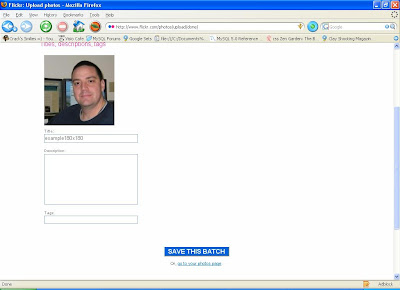
All your pictures are now displayed.
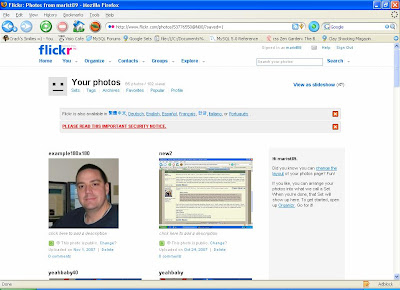
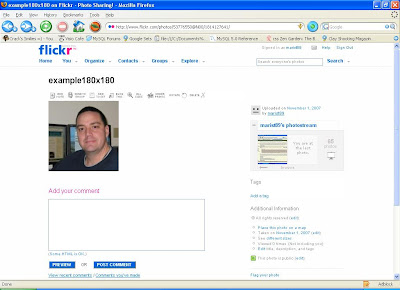
Click on the picture you just uploaded and then click on the "All Sizes" button:
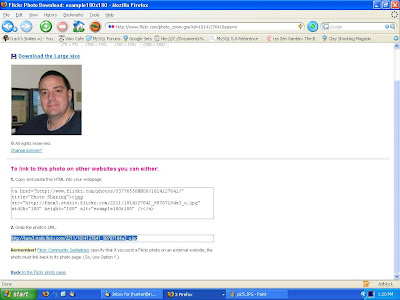
At the bottom of that page, you will see "2. Grab the photo's URL". Copy this URL into your buffer by highlighting it and pressing CTRL+C.
Now, you're done with Flickr. Next, go to the forum you want to post in and compose a message. Type in the text you wish. When you get to the point you want to insert your image, you will enclose the URL from the step above within [img][/img] tags:
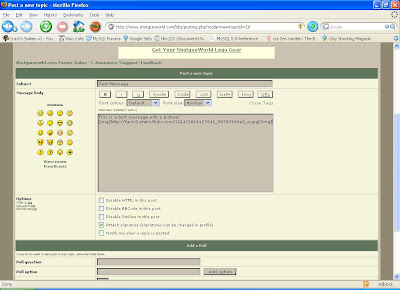
Post your message and the picture will show up inline:

First, you need a third party picture hosting service. I personally prefer Flickr, but there are others like Photobucket and SmugMug out there that allow you to host your pictures for free. You can even host it on your blog on blogger.com! My example will be using Flickr, but really all you need is a URL to the actual image file.
Upload your photo to Flickr. If you don't have a Yahoo account, you can create one for free.

Click "Upload Photo" and either type in the name of your picture file (complete path) or use the "Browse" button to find it. Make sure the "Public" radio button is selected and click "Upload".

Your picture will be uploaded and displayed when it is done. Now, click "Save this Batch".

All your pictures are now displayed.

Click on the picture you just uploaded and then click on the "All Sizes" button:

At the bottom of that page, you will see "2. Grab the photo's URL". Copy this URL into your buffer by highlighting it and pressing CTRL+C.

Now, you're done with Flickr. Next, go to the forum you want to post in and compose a message. Type in the text you wish. When you get to the point you want to insert your image, you will enclose the URL from the step above within [img][/img] tags:

Post your message and the picture will show up inline:

Wednesday, September 12, 2007
There's more than one way to skin a cat
We're off on an adventure trying to figure out why one of our 9.2.0.5 databases has poor response time during a certain period. During the investigation, I came across a process that was executing a query that had a function call in it. It wasn't our problem, but was interesting none the less.
I started tracing the user's session and found that for every row in table T the query was executing function getCount (the names have been changed and the function simplified to clarify the example).
OK, seams reasonable enough, right. But inside getCount() was a query:
Ah, here's the query that showed up in the trace as being the top dog.
"Hmm, let me just fix this and let the developer know how to fix his problem" I thought to myself, "he'll appreciate it."
So I suggested the following query for the fix:
The number of logical reads was much better and the wall clock response time was much better as well. Perfectly suitable solution.
Well, proving that DBAs don't know anything about how to write code, the fix ended up being:
OK, that works. No reason to do something the easy way when you can write code and do it the cool way.
Addition: As Gary points out in the coments, there is a potential in the new function for records with both a '3' AND a '7' to be picked up twice. In my actual data, there is a business rule that makes sure that doesn't happen, but in general it is an issue.
I started tracing the user's session and found that for every row in table T the query was executing function getCount (the names have been changed and the function simplified to clarify the example).
SELECT x, getcount()
FROM t
OK, seams reasonable enough, right. But inside getCount() was a query:
create or replace function getcount return integer
as
   c integer;
begin
   select count(*) into c from xyz where (code1='7' or code2='3');
   return c;
end;
Ah, here's the query that showed up in the trace as being the top dog.
SELECT COUNT(*)
FROM
XYZ WHERE (CODE1='7' OR CODE2='3')


call     count       cpu    elapsed       disk      query    current        rows
------- ------  -------- ---------- ---------- ---------- ----------  ----------
Parse        1      0.00       0.00          0          0          0           0
Execute      1      0.00       0.00          0          0          0           0
Fetch        1      2.47       8.55      57428      63059          0           1
------- ------  -------- ---------- ---------- ---------- ----------  ----------
total        3      2.47       8.55      57428      63059          0           1
"Hmm, let me just fix this and let the developer know how to fix his problem" I thought to myself, "he'll appreciate it."
So I suggested the following query for the fix:
select count(*) from (
select id from xyz where code1='7'
union
select id from xyz where code2='3'
)

call     count       cpu    elapsed       disk      query    current        rows
------- ------  -------- ---------- ---------- ---------- ----------  ----------
Parse        1      0.00       0.00          0          0          0           0
Execute      1      0.00       0.00          0          0          0           0
Fetch        2      0.05       0.05          0        666          0           1
------- ------  -------- ---------- ---------- ---------- ----------  ----------
total        4      0.05       0.05          0        666          0           1
The number of logical reads was much better and the wall clock response time was much better as well. Perfectly suitable solution.
Well, proving that DBAs don't know anything about how to write code, the fix ended up being:
create or replace function getcount return integer
as
   cursor c1 is select count(*) cnt from xyz where code1='7';
   cursor c2 is select count(*) cnt from xyz where code2='3';
   t integer := 0;
begin
   for i in c1 loop
      t := t+i.cnt;
   end loop;
   for i in c2 loop
      t := t+i.cnt;
   end loop;
   return t;
end;
/

SELECT COUNT(*) CNT
FROM
XYZ WHERE CODE2='3'


call     count       cpu    elapsed       disk      query    current        rows
------- ------  -------- ---------- ---------- ---------- ----------  ----------
Parse        1      0.00       0.00          0          0          0           0
Execute      1      0.00       0.00          0          0          0           0
Fetch        2      0.03       0.03          0        387          0           1
------- ------  -------- ---------- ---------- ---------- ----------  ----------
total        4      0.03       0.03          0        387          0           1

SELECT COUNT(*) CNT
FROM
XYZ WHERE CODE1='7'

call     count       cpu    elapsed       disk      query    current        rows
------- ------  -------- ---------- ---------- ---------- ----------  ----------
Parse        1      0.00       0.00          0          0          0           0
Execute      1      0.00       0.00          0          0          0           0
Fetch        2      0.03       0.02          0        279          0           1
------- ------  -------- ---------- ---------- ---------- ----------  ----------
total        4      0.03       0.02          0        279          0           1
OK, that works. No reason to do something the easy way when you can write code and do it the cool way.
Addition: As Gary points out in the coments, there is a potential in the new function for records with both a '3' AND a '7' to be picked up twice. In my actual data, there is a business rule that makes sure that doesn't happen, but in general it is an issue.
Subscribe to:
Posts (Atom)